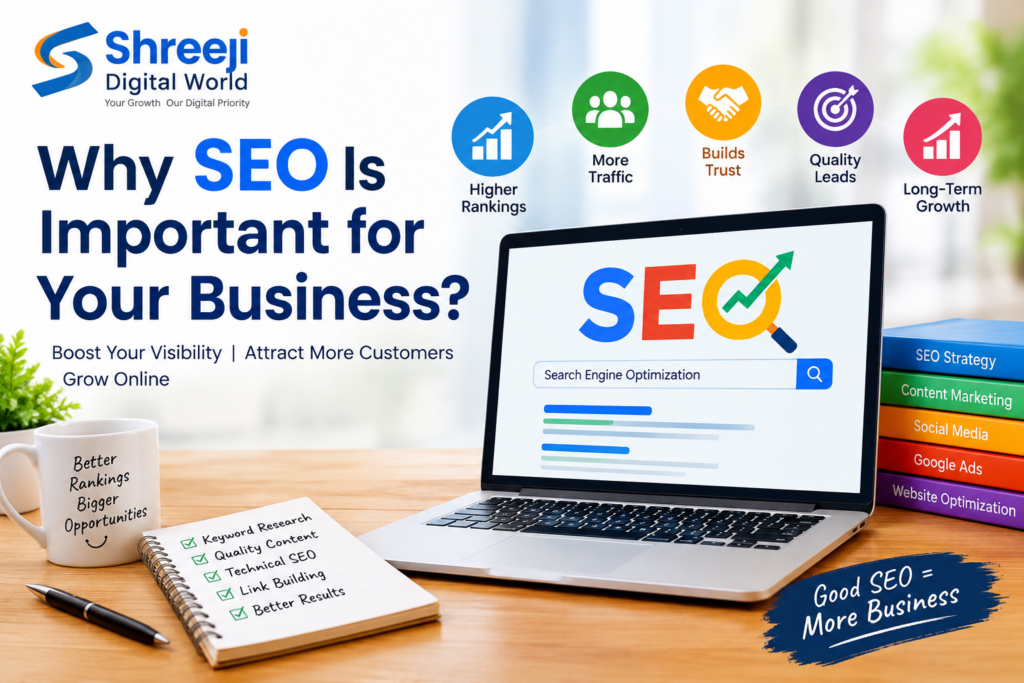
At Shreeji Digital World, we understand that a strong online presence is essential for long-term business growth. In this blog, we will explain why SEO is important, explore its major benefits, and show how it can help your business succeed online.
What Is SEO?
Search Engine Optimization (SEO) is the process of improving a website to help its pages appear more prominently in relevant search engine results.
SEO involves several activities, including keyword research, content optimization, technical improvements, website speed optimization, internal linking, and earning quality backlinks.
For example, if someone searches for “best digital marketing agency in India,” an SEO-optimized website has a better opportunity to appear in relevant search results.
SEO generally includes three major areas:
- On-page SEO: Optimizing titles, headings, content, images, keywords, and internal links.
- Off-page SEO: Building website authority through relevant backlinks, brand mentions, and other external signals.
- Technical SEO: Improving website crawlability, indexing, mobile usability, speed, and site structure.
Together, these activities help search engines understand your website and help potential customers discover your business.
10 Powerful Benefits of SEO for Your Business
1. Improves Your Website’s Google Rankings
One of the main reasons SEO is important is that it helps improve your website’s visibility in search results.
When your website provides relevant, useful content and follows SEO best practices, search engines can better understand your pages and match them with relevant searches.
Higher visibility can help your business attract more potential customers who are already interested in your products or services.
However, Google rankings depend on competition, content quality, website performance, and many other factors. No agency can guarantee a specific ranking.
2. Increases Organic Website Traffic
Organic traffic refers to visitors who reach your website through unpaid search results.
Unlike paid advertising, organic search traffic does not require you to pay for every click. Although SEO requires investment in content, optimization, and maintenance, it can continue generating visitors over time.
For example, a blog targeting “benefits of SEO for small businesses” may attract business owners looking for digital marketing guidance.
With a well-planned SEO strategy, your website can attract relevant visitors and create more opportunities to generate leads.
3. Builds Trust and Brand Credibility
Customers often use search engines to research businesses before making purchasing decisions.
Appearing prominently in relevant search results, publishing helpful content, maintaining an accurate business profile, and earning genuine customer reviews can help establish credibility.
SEO also encourages businesses to create informative pages that answer customer questions.
When visitors consistently find useful information on your website, they may become more confident in your brand.
4. Generates Quality Leads and Potential Customers
SEO is not only about attracting visitors. It is also about reaching people who are actively searching for solutions.
For example, someone searching for “SEO services for small businesses in India” may be closer to hiring an agency than someone browsing general marketing information.
By targeting keywords that match customer needs and adding clear calls to action, businesses can encourage visitors to request a quote, contact the company, or schedule a consultation.
This makes SEO an important part of a lead-generation strategy.
5. Offers Long-Term Marketing Value
Paid advertisements can generate immediate visibility, but traffic from those campaigns usually decreases when spending stops.
SEO works differently. A useful, well-optimized page can continue attracting visitors after publication, although its performance may change with competition, algorithm updates, and content freshness.
This makes SEO a valuable long-term investment for businesses seeking sustainable online visibility.
For the best results, businesses should regularly review performance, update important pages, and improve content based on customer needs.
6. Helps Small Businesses Compete Online
Small businesses often have limited marketing budgets. SEO provides an opportunity to compete for relevant searches by focusing on specific services, customer needs, and local markets.
For instance, a small business can create dedicated pages targeting its services and service areas instead of competing only for broad, highly competitive keywords.
A focused SEO strategy can help small companies reach the right audience and build their online presence over time.
7. Improves Local Search Visibility
Local SEO is especially important for businesses serving customers in a particular city or region.
Optimizing your Google Business Profile, maintaining consistent business information, collecting genuine reviews, and creating useful location-specific pages can help customers discover your business.
For example, a company offering digital marketing services in Ahmedabad can optimize relevant website content for searches related to digital marketing services in Ahmedabad.
Local SEO can support phone calls, direction requests, website visits, and inquiries from nearby customers. Results depend on relevance, distance, prominence, and other factors.
8. Enhances Website User Experience
Effective SEO involves more than keywords. It also focuses on making websites easier to navigate and use.
A well-organized website, clear headings, readable content, mobile-friendly design, and fast-loading pages can improve the visitor experience.
When people can quickly find the information they need, they may be more likely to explore your services or contact your business.
Technical improvements also help search engines crawl and understand your pages more effectively.
9. Supports Other Digital Marketing Strategies
SEO works well alongside social media marketing, content marketing, email marketing, and paid advertising.
For example, keyword research can reveal what your audience wants to know. You can use those insights to develop blog posts, social media content, landing pages, and advertising campaigns.
SEO content can also support your sales team by answering common questions and explaining your services.
Combining these channels creates a more consistent digital marketing strategy.